
Forget the gold watch at 60. Discover how long-term travel planning in India is changing as many tech professionals are taking their big trips now through smart flight hacks to maximise mid-career sabbaticals.

Kunal Jain, 34, a senior product manager at a Bengaluru-based SaaS firm, deliberately and strategically quit his job for three months. He was not fired and did not even burn out. So what made him take this decision? The reason is that he did not want to postpone the thrill of adventure activities in the coastal town of Portugal, a week of diving in Croatia, and a rail journey across the Balkans. After spending a month, he has returned to Bengaluru.
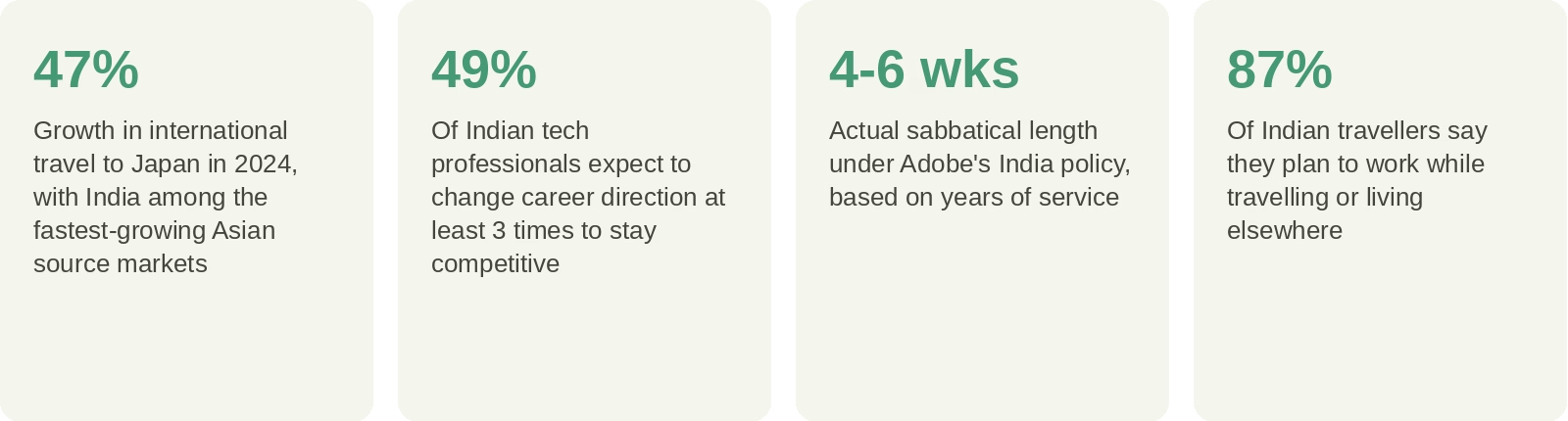
Kunal is not the only case; a quiet shift in long-term travel planning is being witnessed in India’s tech hubs, including Bangalore, Hyderabad, Pune, and Chennai. Professionals with 8 to 15 years of experience are no longer ready to compromise between their careers and exploring the world until their knees give out. Therefore, they are taking sabbaticals from their careers not as a crisis response, but as a planned life event to go on their big adventures. The trend, dubbed micro-retirement, has prompted the aviation industry to adjust to accommodate it.
Why Now?
The logic is quite simple. Retirement at 60 is, statistically, not as golden as it was once. Health constraints creep in, ageing parents may need care, and children’s upbringing can pull you back home. Micro-retirement offers you a chance to enjoy your early 40s in style and experience something new, relax on a beach in the Algarve, or spend six weeks doing absolutely nothing urgent.
What changed in 2025–26 in particular? It is the aviation landscape that makes this financially viable, given the sector’s evolving dynamics since 2020. First, the drop in flight fares for key 2026 destinations in Southeast Asia, Southern Europe, and East Africa has made some multi-stop regional routes a viable alternative to direct flights. Emirates, Qatar Airways, and Air India are aggressively pricing premium economy cabins on routes that pass through their hubs. Second, there is a particular thrill in being on a long-haul, non-stop flight, with the comfort of business class at economy-plus prices for a journey that might span 90 days and four countries, exactly what a micro-retiree wants.
Flight Hacks For Month-Long Escape

Booking a micro-retirement itinerary is very different from booking a two-week holiday in many ways. You are not just looking for one good deal; rather, you are putting together a chain of flights that needs to be flexible, affordable for each leg, and adaptable if you change your mind somewhere around week five.
Here is how India’s savviest mid-career sabbatical travellers are navigating the process:
- Open-jaw tickets over round trips. Book into one city, fly home from another. For example, go from Bengaluru to Lisbon, and return from Istanbul. This saves you from backtracking, and you can use regional trains or budget carriers in between. Start with Skyscanner‘s ‘everywhere’ search.
- Choose hub stopovers, not layovers. Doha, Dubai, and Singapore offer free or cheap stopover programmes. A 48-hour Doha stopover on a Qatar flight to Europe adds another country, costs little, and breaks up a long trip without straining your budget.
- Always choose premium economy over business class. In 2026, the top premium economy seats (Qatar‘s Q Suite neighbourhood, Air India’s new A350 cabin, and Singapore Airlines‘ premium economy) offer 75% of the comfort at 40% of the cost of business class. Particularly for a multi-leg, six-week trip, these savings are considerable.
- Book the anchor flights in advance, but keep the middle flexible. The first rule is to buy the long-haul legs (intercontinental flights) 90 to 120 days early to catch price drops, and the regional ones (Delhi-Tbilisi via Istanbul, Colombo-Bali via Bangkok on IndiGo or AirAsia) 2 to 3 weeks in advance. The shorter the distance, the less sense it makes to purchase tickets well in advance, as fares for local and regional routes rarely reward early booking.
- Use multi-stop booking tools over airline websites. Kiwi.com‘s ‘nomad’ feature and Google Flights’ multi-city mode are perfect for this. These platforms show routing options that airline websites do not, including self-transfers that can save thousands of rupees.
Coastal Rail & Boutique Cruise Layer
Not everything moves by flights. A well-planned micro-retirement usually has two components: a slower pace and greater relaxation. Think of Portugal’s Douro Valley via train or a small-ship cruise through the Adriatic that carries only 32 passengers and stops in Hvar for lunch. Or the overnight train from Tbilisi to Batumi. These are not add-ons; they are indispensable.
Noticing this micro-retirement trend, boutique cruise operators such as Ponant, Variety Cruises, and a growing number of Indian-Pacific operators are offering 7–10-day coastal cruises that fit neatly into multi-stop flight itineraries. You can fly into Dubrovnik, cruise to Athens, and fly home from there. The flight booking and the cruise become one connected plan, not two separate vacations.
Is This New, Or A Rebrand?

Sabbaticals have been in academia for a century. However, now we are witnessing a natural evolution of this concept. What is actually new here is that this trend is becoming normal in India’s corporate and startup ecosystem. Financial tools now make it possible: from airline credit cards with milestone bonuses to UPI-linked travel wallets that offer discounts and travel insurance companies that reimburse expenses if a flight is delayed by more than 12 hours. There is also the remote-work infrastructure that allows an individual to convert a short-term sabbatical into a longer one.
The ‘micro’ in micro-retirement is significant, but this is not about dropping out. The term is misleading, since these are not retirements at all but rather brief pauses in one’s career to reflect, reset, and recalibrate. It is this element of reflection that makes micro-retirement different from other types of travel. This is also why airlines and cruise lines are so interested in them. This is not a backpacker market, but rather a 34-year-old with savings and refined tastes looking to upgrade to a premium economy seat for most of his 90-day itinerary.
Kunal returned to work at a different company with a clearer sense of what he wanted from his career. The trip is not an escape from a career; it is a recalibration of it.
Where To Begin
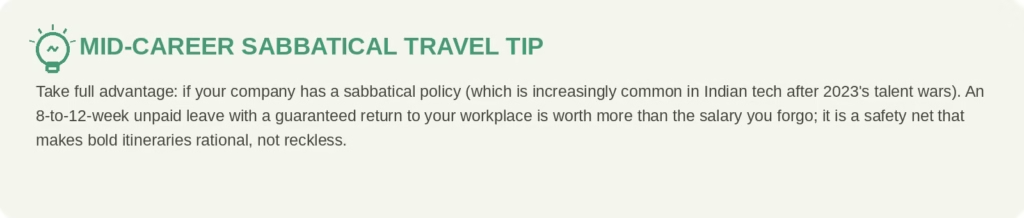
The single most important piece of advice while planning long-term travel is not to get fixated on the itinerary before confirming the fundamentals: talk to your employer first, book anchor flights second, design everything else third. Sharing their experiences, many micro-retirement planners in Bengaluru said that their beautifully crafted eight-country itineraries went down the drain because they did not have a formal agreement with their companies regarding the sabbatical.
Once that is done, the rest will follow. You need to choose your farthest destination first, and then build upon it. It is also a good idea to keep a buffer of ₹40,000-60,000 for mid-trip route changes, because you will likely find a place where you want to stay longer or leave faster. That budget is not just a backup; it is the cost of experiencing travel more like a person than a strict itinerary.

The micro-retirement is not a millennial dream. It is a practical rearrangement of when you take your biggest trip. This new aviation trend is not only millennials’ cup of tea but is also being followed by Gen Z. And the aviation sector is finally pricing itself to meet this demand.
Note: The numbers and route recommendations provided in this article are for reference only. As flight fares and seat availability are subject to change, it is always advisable to verify the current pricing via your preferred booking platform before planning.